
How Optimizing One Workflow Delivers $60k/yr in Savings - Inside an AI Opportunity Assessment
A Case Study In Healthcare

By the end of this case study, you will know how we run an opportunity assessment at CogniStark — how we:
investigate workflows using client’s operational data + interviews
map workflows, record current state (for benchmarking)
model ROI, present projected transformation
score AI opportunities based on ‘fit’
recommendations/considerations
rapid proof of concept
This is hypothetical case study based on real healthcare data.
Our hypothetical Client: Healthcare - behavioral health clinic
Number of full-time employees: 45
Client relies on CRM, communication, and documentation tools
The clinic suspected rising admin burden and inconsistent documentation quality, but did not know which workflows were leaking time, money, or introduced compliance risk, or how to quantify those to have an estimation of cost of inaction.
Data & Task Mining
Targeted workflows/systems, based on client’s initial vision and concerns were:
Telehealth: communication, transcription, summarization
Compliance QA & insurance check
CRM/EHR updates & handoffs
Onboarding new hires
Task creation
Scheduling was already automated.
Examples of the data reviewed:
Audit & handoff logs
Task logs & reminders
Training & onboarding logs
Recordings, transcripts, call logs
Error logs from manual transcriptions
Templates/structured forms used by staff
Roles of people interviewed:
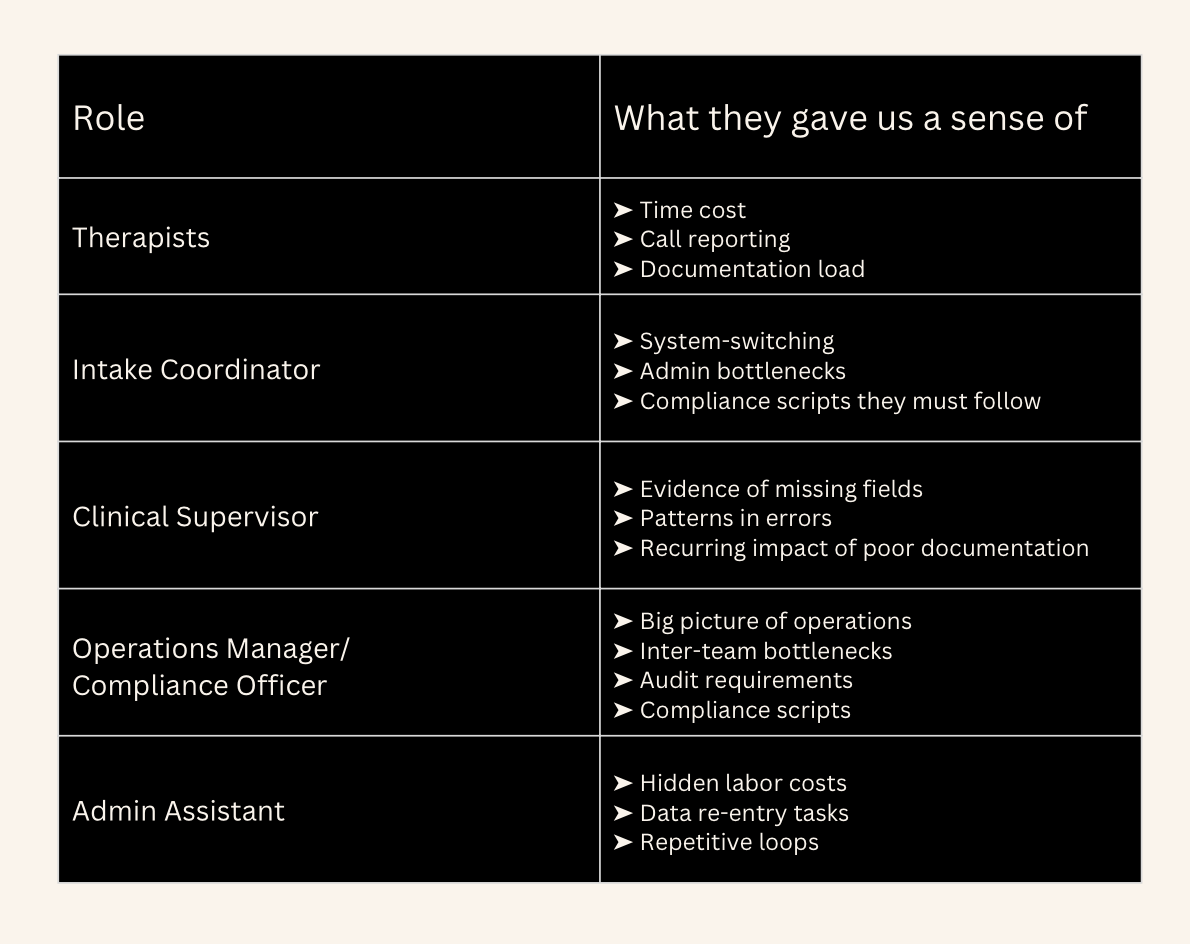
The extracted info from the interviews and data review gave us enough insight to map bottlenecks, discover AI and/or automation-shaped gaps, model ROI, and make recommendations grounded in evidence.
Along with the info gathered and extracted, there was another important insight gained. It appeared that the overall culture was resistant to change (i.e., AI/automation integration), mainly due to two reasons:
Privacy concerns
They were under the assumption that AI/automation would replace them
We held a 60-minute remote call involving the staff for the purpose of education, which was split into two parts:
40 minutes: demystify AI/automation, clarify privacy protections and how data is handled, and reinforce that the objective is augmentation, not replacement.
20 minutes: Q&A
During the assessment, workflows were mapped out for the client in a clear way. We included both current state —and recorded it as the baseline— and what they’d transform to, after optimization.
Example:
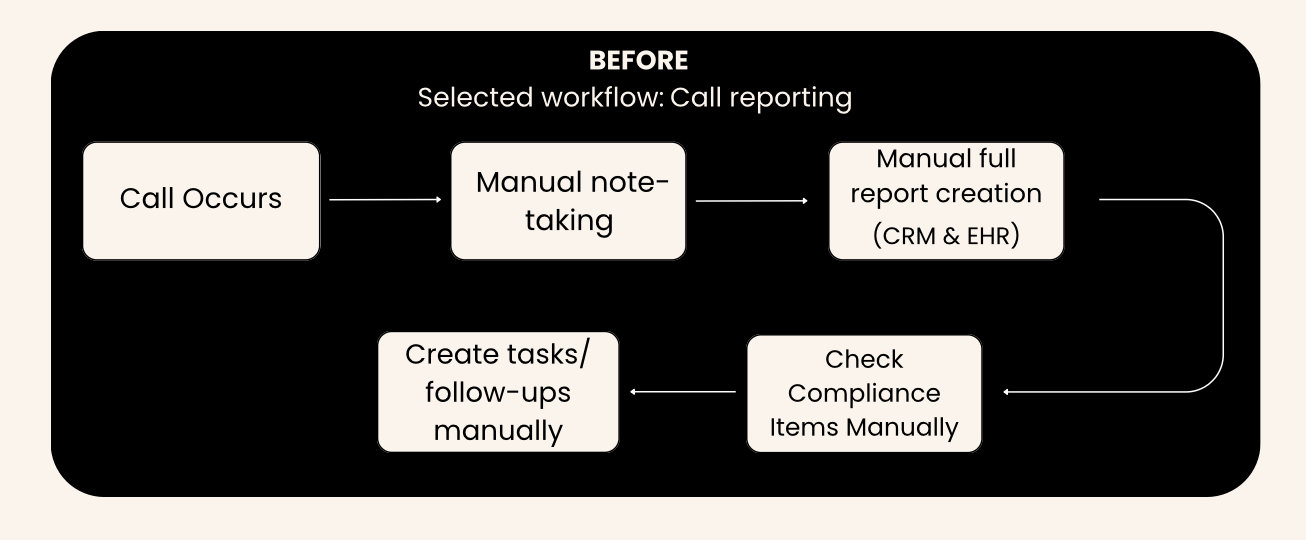
Macro view of issues found
High documentation time per call
Staff reported spending approx. 45 minutes per one call report on average.
Data entry errors observed repeatedly:
➤ Staff updated SimplePractice & Microsoft Dynamics with the same info.
➤ Inaccurate start/end times for telehealth sessions
➤ Incorrect diagnosis code
➤ Errors in patient info
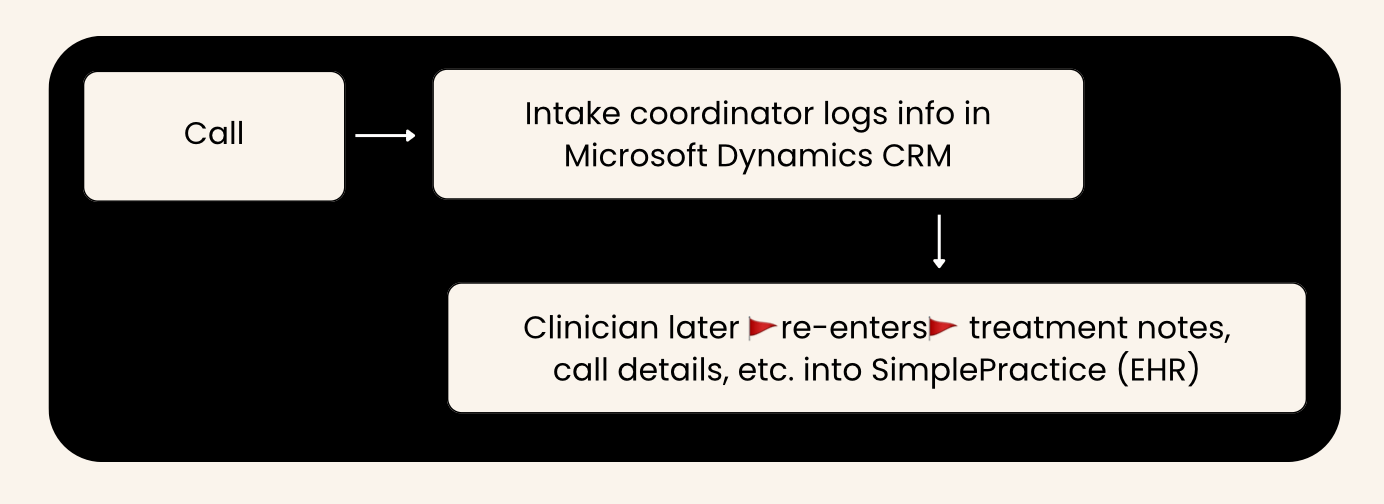
Compliance marker inconsistency, missing fields, errors:
4 out of 20 call report we reviewed showed missing or incomplete identity verification.
Unstructured notes slowing downstream teams
Supervisors needed to re-read lengthy notes to extract actions/risks.
Summary of Findings
CogniStark assessed 5 healthcare workflows.
What we found:
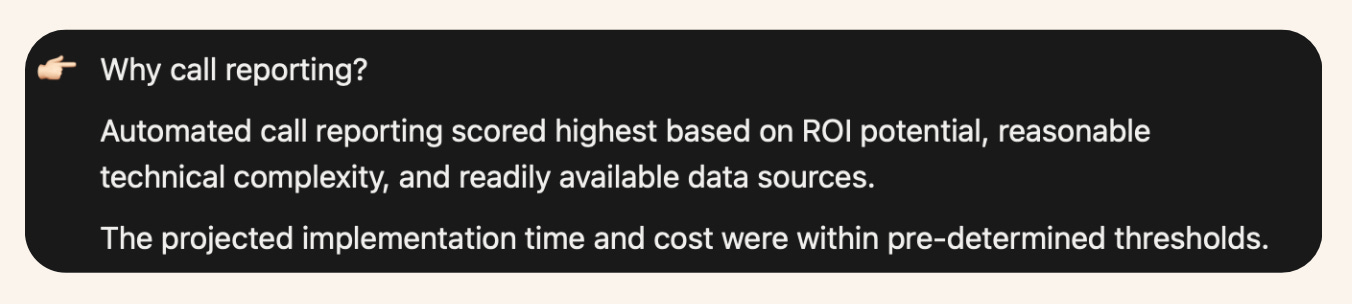
Results indicated call reporting as the largest measurable admin burden with the clearest path to optimization. This meant highest ROI, reasonable technical complexity, sufficient resources (data & budget) to support the implementation.
Both compliance QA automation and CRM auto-update showed lower projected ROI than automated call reporting. That said, CRM auto-update was more feasible than compliance QA automation; thus it’d be the second best option.
The client’s current documentation inconsistency would have increased implementation effort for compliance QA automation (low readiness) ⇒ less suitable for a rapid proof-of-concept (POC).
Task creation automation was deprioritized due to lower ROI despite very high feasibility and very low technical complexity.
Onboarding assistant scored a very low ROI. This was due to the clinic’s high standard for a specific skillset and level of knowledge of the new hires, historically. The training time wasn’t significant enough comparison to other manual work.
Moment of truth
👉🏻 Opportunity Ranking (decision Matrix) 👈🏻
This is the part where the client was presented with a summary of our report, including recommendations.
CogniStark’s presentation included a simple visualization to show how the recommended solutions ranked:
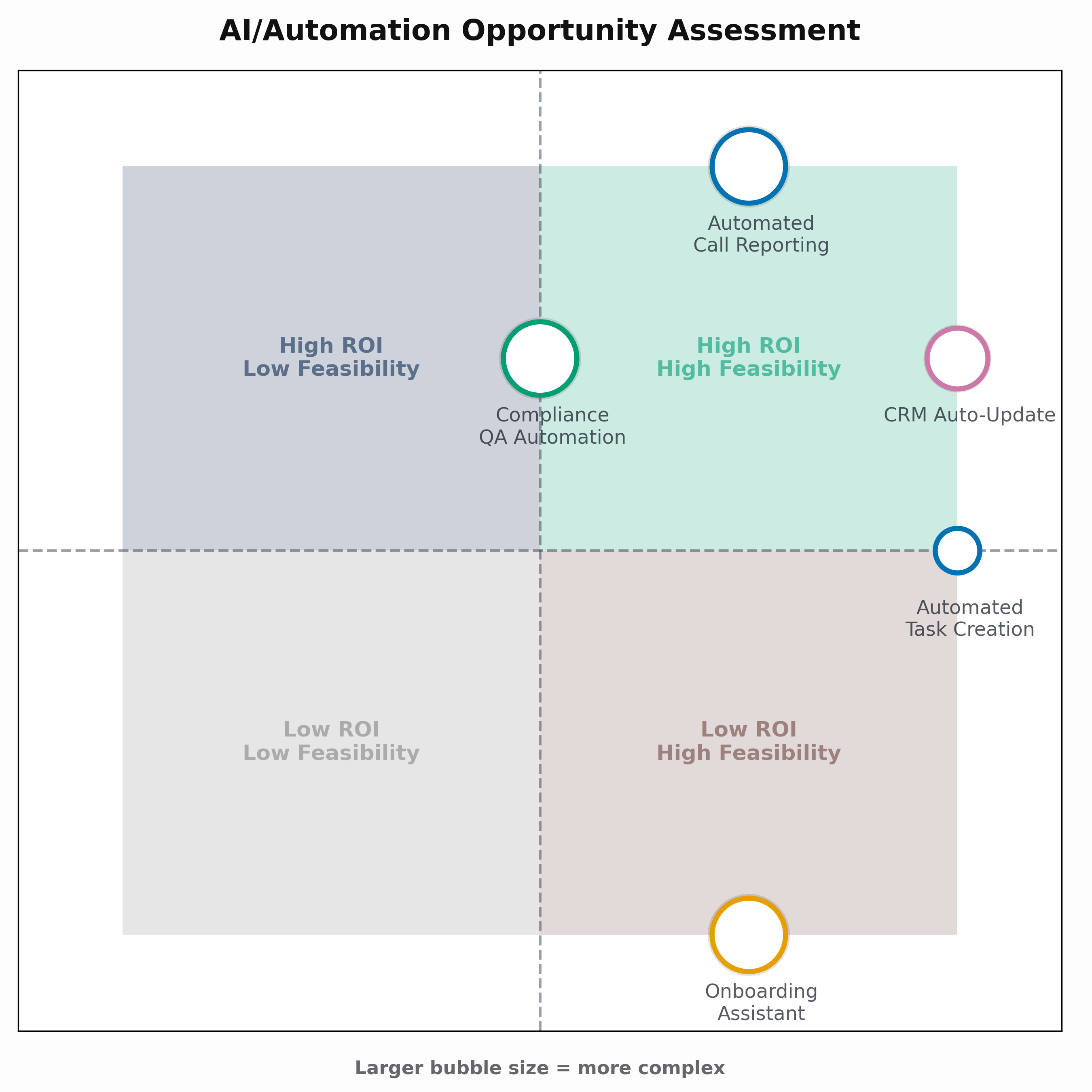
About the decision matrix above:
The larger the bubbles, the more the technical complexity.
The ‘feasibility’ in the above takes into account implementation cost & time, and data availability. A good rule of thumb is that the project’s price ≤ 8-10% of annual savings. Time on the other hand, is pre-determined and agreed-upon.
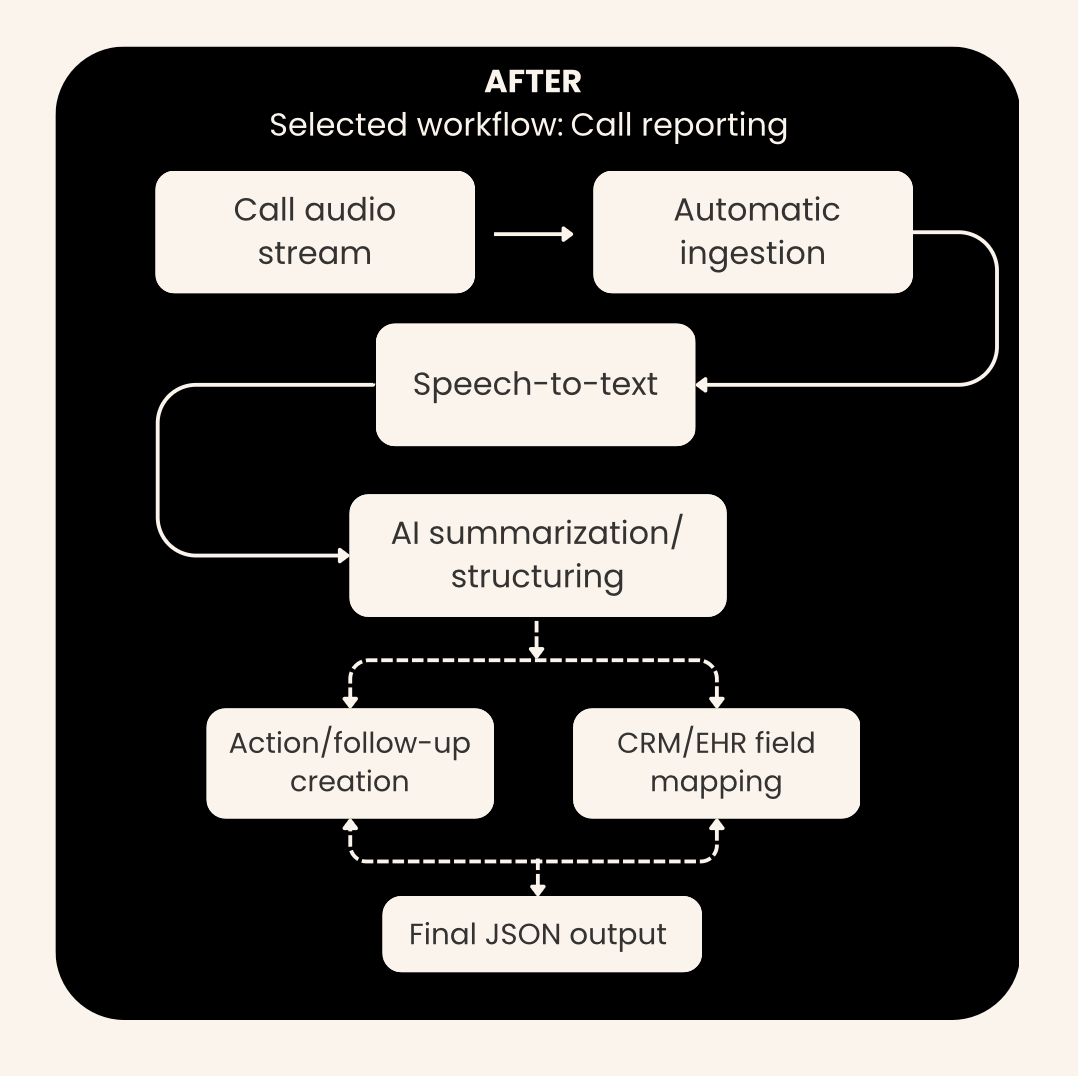
A simple demo of call reporting flow transformation (after integrating AI and automation) was presented to the client:
A Quick Simulation of Projected ROI
We’re assessing impact of only one workflow optimization — call reporting.
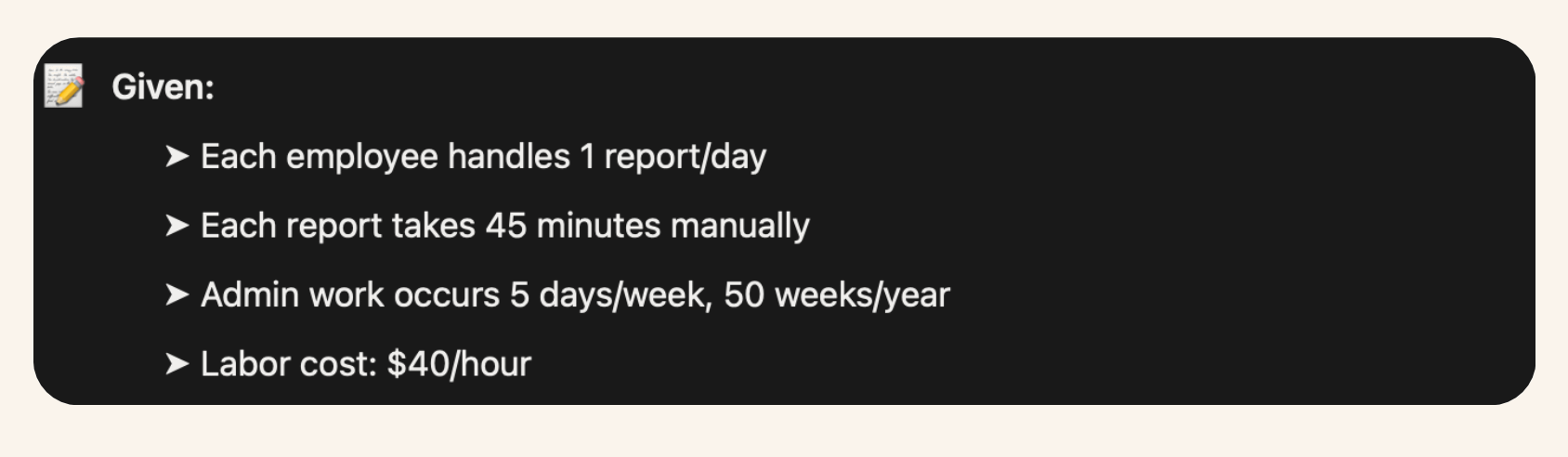
Annual Time Spent Today:
20 of the employees are involved in the call reporting task (40hrs/week per individual).
Each employee handles 1 report/day (45 minutes), happens 5 days a week, 50 weeks/year (reserving 2 weeks for holidays, etc.)
So:
Annual time spent =
20 employees × 1 report/day × 3/4 hr × 5 days × 50 weeks
= 3750 hrs/year
Based on insights from call logs and interviews, we learned:
About 30 minutes of one full call reporting was mechanical and doesn’t involve human judgment.
The compliance & insurance checks took about 9-10 minutes on average (excluded from our solution).
We were left with 20 minutes (about 44% of one full call reporting). The conservative route of modeling would give us a 40% time saving per one call reporting. Thus, the AI+automation solution recommended would reduce call reporting time by 40%.

And that’s one workflow.
Considerations - specific to healthcare
If LLMs in the loop:
A cloud LLM service with a Business Associate Agreement is recommended.
LLM outputs would be subject to a structured auditing process.
This includes:
➤ periodic accuracy checks against human-generated reports
➤ monitoring for hallucinations/inconsistencies
➤ documented escalation(rate) for incorrect outputs
Conclusion
AI and automation both have major impact on healthcare workflow optimization. However, it should be taken into account that a targeted assessment prevents wasted spend and ensures that every AI initiative starts with clear financial impact, operational feasibility, and defensible reasoning. The actual workflows need to be mapped and the final result should be modeled before taking a step toward implementation. In case of higher complexities, risks are required to be carefully assessed before any implementation.
Additionally, should the organization proceed with implementation, all model outputs would follow a formal auditing workflow and monitoring for inconsistencies. In a GenAI-powered workflow, ensuring the system remains trustworthy and aligned with standards is key.
And finally, cultural and educational components are critical. It’s not recommended to treat bringing staff up to speed as afterthought.
Ready for your AI/automation opportunity assessment?
Or start by getting an estimate of how your operational inefficiencies are impacting you here.
Thanks for reading!
Cheers,
Nicko